
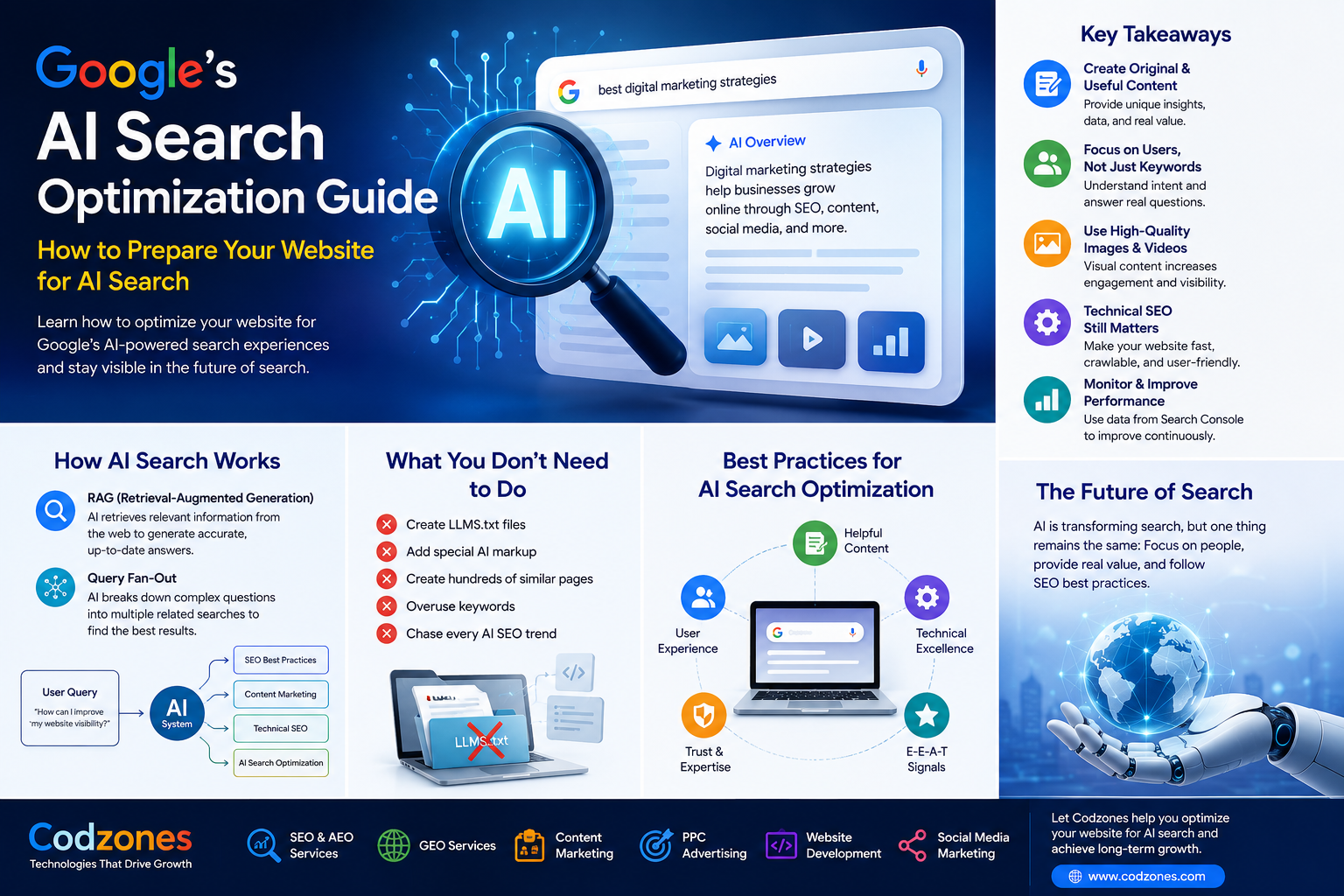
Google’s AI Search features, including AI Overviews and AI Mode, are changing how websites can appear in search results. But does this mean traditional SEO is no longer important?
No.
Google’s latest guidance makes it clear that traditional SEO best practices continue to matter for generative AI search because Google’s AI search features are connected to its core Search ranking and quality systems.
For businesses, this means the goal should not be to chase every new AI SEO trend. Instead, focus on creating useful content, maintaining a technically strong website, and giving users information they can trust.
In this guide, we explain what Google’s latest AI search guidance means for your website and how you can prepare for the future of search.
What Is AI Search Optimization?
AI search optimization is the process of improving your website so that its content can be discovered, understood, and potentially surfaced in AI-powered search experiences.
You may also hear terms such as:
- AI SEO
- Answer Engine Optimization (AEO)
- Generative Engine Optimization (GEO)
- Generative AI SEO
- AI Search Optimization
These terms are commonly used in the digital marketing industry. However, Google explains that optimizing for generative AI search is still fundamentally part of optimizing for Search.
This is important because businesses do not necessarily need a completely separate SEO strategy for AI search.
Instead, they need to improve the quality, usefulness, accessibility, and technical foundation of their existing website.
Is Traditional SEO Still Important for Google AI Search?
Yes.
Google states that SEO best practices remain relevant because its generative AI search features are built on Google's core Search ranking and quality systems.
Google uses AI techniques to find and understand relevant information from its Search index.
Two important concepts mentioned in Google's guidance are Retrieval-Augmented Generation (RAG) and query fan-out.
Retrieval-Augmented Generation (RAG)
RAG, also known as grounding, helps AI systems create more accurate and up-to-date responses by retrieving relevant information from the web.
The system can find relevant pages from Google's Search index and use information from those pages to help generate a response. Relevant links can also be shown to users.
This makes it important for businesses to ensure that their important pages are:
- Crawlable
- Indexable
- Relevant
- Helpful
- Well structured
- Supported by reliable information
Query Fan-Out
Query fan-out means the AI can generate several related searches to better understand and answer the user's original question.
For example, someone may search:
"How can I improve my website's online visibility?"
The system could explore related topics such as:
- SEO best practices
- Content marketing strategies
- Technical SEO
- AI search optimization
- Website user experience
This means your website does not always need to use the exact wording of a user's search query. Google says its systems can understand the relevance and meaning of pages even when there isn't an exact match between the query and the page's main content.
7 Ways to Prepare Your Website for AI Search
1. Create Original and Useful Content
One of the most important recommendations from Google is to create content that is unique, useful, and valuable to your audience.
Avoid simply rewriting information that already exists on other websites.
Instead, add:
- Original research
- Expert opinions
- First-hand experience
- Real examples
- Case studies
- Data and statistics
- Practical recommendations
- Unique insights
For example, instead of writing a generic article called "10 SEO Tips," create something more useful such as:
"How We Improved a Local Business Website's Organic Visibility: SEO Lessons From a Real Campaign."
The second topic has the potential to provide experience and insights that readers cannot easily find elsewhere.
Google specifically recommends creating content that goes beyond common or "commodity" information.
2. Write for People, Not Just Search Engines
Your content should be easy for real users to read and understand.
Use:
- Clear headings
- Short paragraphs
- Bullet points
- Simple language
- Descriptive subheadings
- Examples
- Helpful FAQs
- Logical content structure
Don't create content only because a keyword has search volume.
First ask:
What does the user actually want to know?
Then create the best possible answer.
This people-first approach can help your content work across both traditional search and AI-powered search experiences.
3. Add High-Quality Images and Videos
Text is not the only type of content that can help users.
Google explains that its generative AI search experiences can surface relevant images and videos, creating additional opportunities for websites to appear beyond traditional webpage links.
Where appropriate, add:
- Original images
- Product images
- Infographics
- Screenshots
- Demonstration videos
- How-to videos
- Charts and diagrams
Make sure your visual content is relevant to the page and follows good image and video SEO practices.
4. Keep Your Website Technically Strong
High-quality content cannot perform properly if search engines cannot access or understand your website.
Google recommends continuing to follow foundational technical SEO practices, including making sure pages can be crawled and indexed.
Important areas include:
- Crawlability
- Indexability
- XML sitemap
- Robots.txt
- Canonical URLs
- Internal linking
- Mobile usability
- Page experience
- JavaScript SEO
- Duplicate content management
- Website speed
Google also recommends using Search Console to identify and diagnose potential technical problems.
5. Don't Create Hundreds of Pages Just for AI Search
More content does not automatically mean better SEO.
Some businesses may be tempted to create separate pages for every possible keyword variation or AI-related search query.
This can create large amounts of similar or low-value content.
Google warns that creating content primarily to manipulate rankings or generative AI responses can violate its scaled content abuse spam policy.
Instead of creating 20 pages that answer nearly the same question, create one strong resource that provides a complete and useful answer.
Quality should come before quantity.
6. Don't Depend on LLMS.txt or Special AI Markup
There is a lot of discussion online about files such as LLMS.txt and special AI-focused markup.
However, Google's current guidance says that you do not need to create these files to appear in Google Search or its generative AI features. Google Search does not use them in a special way.
The same applies to the idea that you need a special AI schema just to appear in Google's AI search.
Structured data can still be useful as part of a broader SEO strategy, especially for eligibility for supported rich results, but Google says there is no special schema required specifically for generative AI search.
7. Monitor Your Performance
SEO is not a one-time activity.
After publishing and optimizing content, monitor how your website performs.
Google recommends using Search Console to understand how content is performing in generative AI features. Its Generative AI performance reporting can provide insights into how people discover your content through these experiences.
You should also monitor:
- Organic traffic
- Impressions
- Clicks
- Search queries
- Average position
- Indexed pages
- Top-performing content
- Conversion rates
- Engagement
- Technical SEO issues
Use this data to improve your strategy over time.
What About AEO and GEO?
AEO and GEO have become popular terms in digital marketing.
AEO generally refers to Answer Engine Optimization, while GEO refers to Generative Engine Optimization.
These approaches focus on improving visibility in AI-powered search and answer experiences.
However, Google's guidance says that optimizing for generative AI search is still fundamentally part of optimizing for Search.
That means businesses should be careful about agencies or tools promising guaranteed AI rankings through secret techniques.
There is no shortcut that replaces:
Good SEO + Great Content + Strong Technical Foundation + Real Value for Users
What You Don't Need to Do for Google AI Search
Google's guidance also clears up several common misconceptions.
You don't need to:
- Create LLMS.txt specifically for Google
- Break every article into tiny "AI chunks"
- Rewrite every page only for AI systems
- Add unnecessary long-tail keyword variations
- Create hundreds of similar pages
- Build artificial mentions across the internet
- Add special schema only for AI search
Google's systems are designed to understand the meaning and relevance of content, including variations in how people search.
How Codzones Can Help With AI Search Optimization
Businesses need more than just rankings. They need visibility where their customers are searching.
Codzones provides website development and digital marketing services, including SEO, Answer Engine Optimization, Generative Engine Optimization, content marketing, social media management, and PPC advertising.
A strong AI-search strategy can include:
Technical SEO
Make sure search engines can crawl, understand, and index your website properly.
Content Optimization
Create useful, original, people-first content that answers real customer questions.
AEO
Structure content around questions and answers to improve its usefulness across answer-focused search experiences.
GEO
Develop a broader content and visibility strategy for generative AI search experiences.
Content Marketing
Build topical authority through useful resources, guides, case studies, and original insights.
Website Development
Create fast, user-friendly, technically sound websites that support long-term SEO and digital marketing goals.
Codzones combines web development, design, technology, and digital marketing services under one roof, which can help businesses align their website and marketing strategies instead of treating them as separate activities.
Final Thoughts
Google's latest AI search guidance sends an important message:
You don't need to abandon SEO because AI search is growing.
Instead, you should improve the fundamentals.
Create content that people genuinely want to read. Provide original insights. Make your website technically accessible. Use relevant images and videos. Keep your pages easy to navigate. Avoid low-value content created only to target search variations.
Most importantly, don't chase every new AI SEO "hack."
The future of search is becoming more conversational and AI-powered, but the basic goal remains the same: help users find useful, trustworthy information.
Businesses that build their websites around users—not just algorithms—will be better prepared for both traditional Google Search and the growing world of generative AI search.