
Keyword research has always been one of the foundations of successful SEO. But search behavior is changing rapidly. People are no longer relying exclusively on traditional search engines to discover information, products, and services. They are increasingly using AI-powered platforms such as Claude, ChatGPT, Gemini, and Perplexity to ask detailed questions and explore solutions.
This shift creates a new opportunity for businesses: combining traditional keyword research with artificial intelligence to understand not only what people search for, but why they search for it and how they describe their problems.
Claude can help marketers generate keyword ideas, identify search intent, organize topics, analyze customer language, discover content gaps, and build content clusters. However, AI-generated keyword suggestions should not automatically be treated as verified search data. The strongest approach combines Claude's language understanding with actual search and website performance data.
For businesses investing in SEO, Answer Engine Optimization (AEO), and Generative Engine Optimization (GEO), this combined approach can create a more comprehensive search strategy.
What Is Claude Keyword Research?
Claude keyword research is the process of using Claude's AI capabilities to discover, organize, analyze, and expand keyword ideas for a website or content strategy.
Instead of starting with a single keyword and generating hundreds of variations manually, marketers can provide Claude with information about:
- Products and services
- Target customers
- Customer pain points
- Existing website pages
- Competitor content
- Google Search Console data
- Customer reviews
- Sales conversations
- Frequently asked questions
- Industry terminology
- Existing keyword lists
Claude can then use this context to identify relationships between topics, questions, problems, and search phrases.
For example, a traditional keyword research process for a web development company might begin with:
"website development company."
An AI-assisted process can expand the research into related customer needs such as:
- custom website development services
- website development company for small businesses
- B2B website development services
- responsive website development
- website redesign services
- how much does custom website development cost
- best technology for business websites
- website development for healthcare businesses
The result is a broader understanding of the topic and the audience behind it.
Why Use Claude for Keyword Research?
Traditional keyword tools are extremely useful because they provide important metrics such as search volume, competition, keyword difficulty, and related queries.
Claude provides something different: contextual understanding.
It can analyze large amounts of unstructured information and identify patterns in the language customers use.
This makes Claude particularly useful for:
1. Generating keyword ideas
Claude can turn a broad business topic into hundreds of potential keyword concepts and questions.
2. Understanding search intent
It can categorize queries according to the reason behind the search, such as informational, commercial, transactional, or navigational intent.
3. Finding long-tail keywords
AI can identify conversational and highly specific queries that may be overlooked during traditional keyword research.
4. Creating topic clusters
Claude can organize related keywords into topic groups that can become blog posts, service pages, FAQs, or supporting content.
5. Analyzing customer language
Reviews, conversations, comments, and support questions can reveal how real customers describe their problems.
6. Supporting AEO and GEO
Conversational questions and natural-language queries can help marketers create content that provides clear answers for AI-powered search experiences.
Claude vs. Traditional Keyword Research
Claude should not necessarily replace traditional keyword research platforms. Instead, the two approaches can complement each other.
A keyword research platform can provide quantitative information such as:
- Search volume
- Keyword difficulty
- CPC
- Competition
- Ranking data
- SERP information
- Competitor keyword data
Claude can help with qualitative analysis such as:
- Search intent
- Customer language
- Topic relationships
- Question discovery
- Content clustering
- Content gaps
- Query expansion
The best workflow combines both.
AI generates and interprets ideas. Search data validates demand.
This distinction is important because an AI model can generate a realistic-sounding keyword that has little or no measurable search demand.
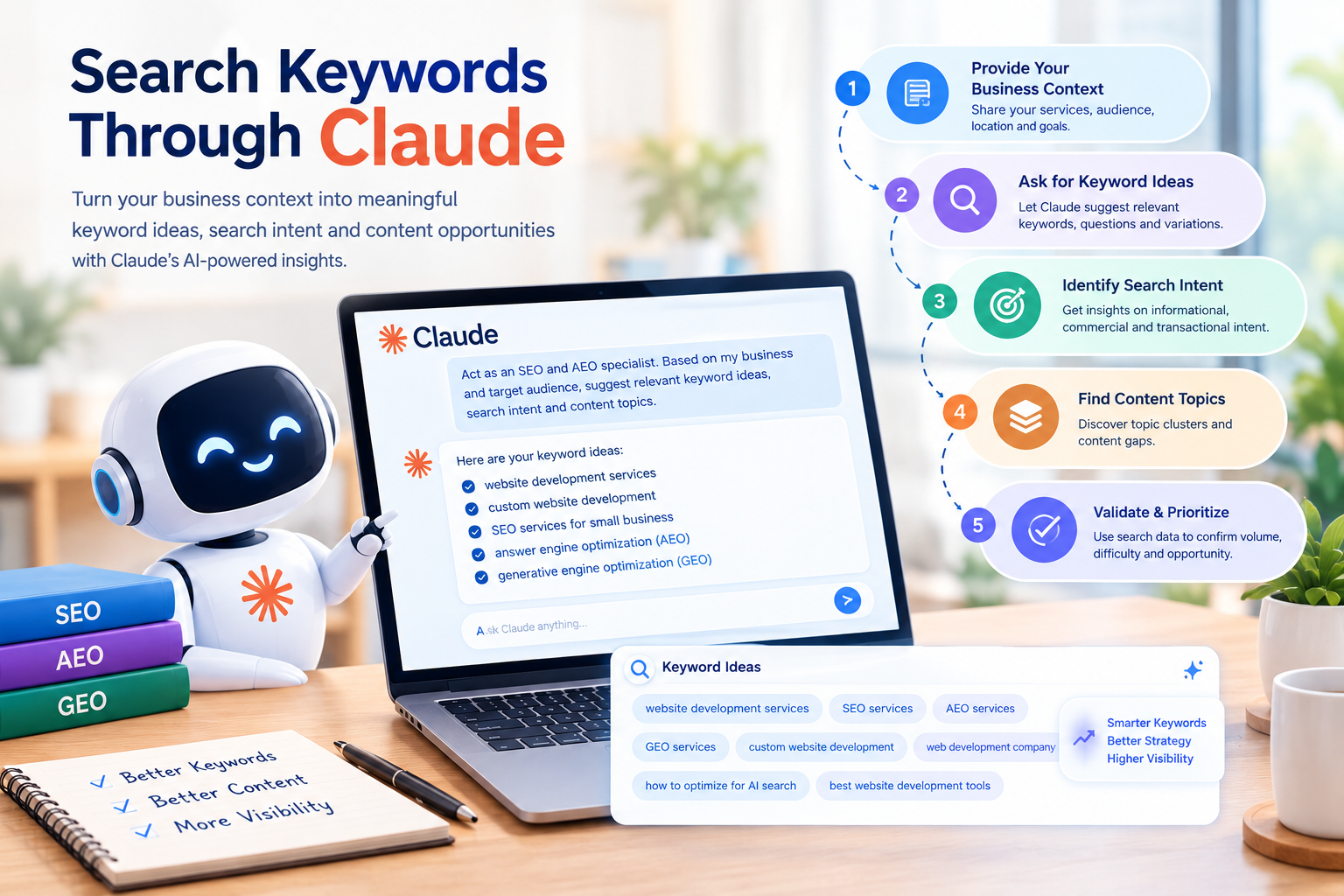
Here is a practical workflow businesses can use.
Step 1: Give Claude Your Business Context
Before asking Claude for keywords, provide detailed information about your business.
Include:
- Business name
- Products or services
- Target audience
- Geographic markets
- Customer problems
- Main competitors
- Unique selling points
- Existing website pages
- Industry terminology
- Content goals
For example, a digital technology agency could provide Claude with information about its website development, SEO, AEO, GEO, CRM development, mobile application development, and digital marketing services.
The more relevant context Claude receives, the more useful its keyword suggestions can become.
Step 2: Create a Seed Keyword List
Start with your main business categories.
For example:
Website Development
- website development
- custom website development
- web development company
- business website development
SEO
- SEO services
- technical SEO
- local SEO
- enterprise SEO
AEO
- answer engine optimization
- AEO services
- optimize content for AI answers
- AI search optimization
GEO
- generative engine optimization
- GEO services
- optimize website for AI search
- AI visibility optimization
Ask Claude to expand these seed topics into related keywords, questions, and conversational searches.
Step 3: Ask Claude to Identify Search Intent
Not every keyword should be targeted with the same type of page.
For example:
"What is technical SEO?"
This is primarily informational.
"technical SEO services for small business"
This may have commercial intent.
"hire technical SEO agency"
This is closer to transactional intent.
Ask Claude to classify your keyword list by intent.
This helps determine whether a query belongs on:
- Blog content
- Service pages
- Landing pages
- Product pages
- FAQ sections
- Comparison pages
- Case studies
Step 4: Find Long-Tail Keyword Opportunities
Long-tail searches often contain more context than broad keywords.
Instead of targeting only:
"SEO services"
you could investigate queries such as:
- SEO services for small businesses
- affordable SEO services for local businesses
- SEO agency for healthcare companies
- how to improve Google rankings for a business website
- SEO services for businesses in New York
Claude can help expand broad topics into these conversational variations.
For AEO and GEO, long-tail and question-based queries can be especially useful because users frequently ask AI systems complete questions rather than short keyword phrases.
Step 5: Analyze Customer Reviews
Customer reviews are an excellent source of keyword ideas because they contain authentic customer language.
For example, suppose customers repeatedly mention:
"We were getting website visitors but not enough leads."
That feedback could lead to content topics such as:
- why website traffic isn't generating leads
- how to improve website conversion rates
- website optimization for lead generation
- SEO strategies for increasing qualified leads
Instead of guessing how customers describe their problems, you are using language based on real experiences.
Step 6: Analyze Reddit and Online Discussions
Online communities can reveal questions and frustrations that may not appear in conventional keyword tools.
Marketers can analyze relevant discussions to discover:
- Frequently asked questions
- Common complaints
- Product comparisons
- Customer objections
- Industry terminology
- Emerging topics
- Problems users struggle to solve
Claude can summarize these discussions and convert recurring problems into potential content topics and search queries.
However, these ideas should still be validated before becoming major SEO targets.
Step 7: Use Google Search Console Data
Your own Google Search Console data can be extremely valuable.
Export your search queries and give the data to Claude for analysis.
Ask it to identify:
- Keywords ranking between positions 8–20
- High-impression keywords with low CTR
- Keywords generating impressions but few clicks
- Queries without a dedicated page
- Keyword cannibalization opportunities
- Existing pages that could be improved
- New content opportunities
For example, if a page is already ranking around position 11 for a relevant keyword, improving that existing page may be more practical than creating a completely new page.
This is an important part of an AI-powered SEO workflow because it uses your website's actual performance data.
Step 8: Perform Competitor Keyword Gap Analysis
Claude can help organize competitor keyword research.
Start by identifying relevant competitors and asking:
- What topics do competitors cover?
- Which keywords appear repeatedly?
- Which services have dedicated pages?
- What questions do competitors answer?
- Which content formats are they using?
- Which topics appear to be missing from our website?
The resulting keyword ideas can then be validated using SEO tools.
A competitor ranking for a keyword does not automatically mean your business should target it. Relevance, search intent, business value, and competition should all be considered.
Step 9: Validate AI-Generated Keywords
This is one of the most important steps.
Never assume that every keyword generated by Claude has meaningful search volume.
Use keyword research and search performance data to validate:
- Search volume
- Keyword difficulty
- Search intent
- CPC
- SERP competition
- Existing rankings
- Related queries
Some AI-generated phrases may show zero measurable search volume.
That does not always mean the topic is useless. A phrase may represent a new or highly specific way people express a problem.
However, it should be treated as a content idea rather than automatically being considered a high-priority SEO keyword.
Step 10: Cluster Keywords by Topic
Once you have validated your keywords, organize them into topic clusters.
For example:
Core Topic: Website Development
Supporting topics:
- custom website development
- responsive website development
- business website development
- website redesign
- website development cost
- CMS development
- website performance optimization
These keywords may not require separate pages.
Instead, one comprehensive page can potentially address several closely related queries.
This helps create a logical website structure and reduces the risk of producing multiple pages targeting nearly identical search intent.
Claude Keyword Research for AEO
Answer Engine Optimization focuses on improving content so that it can provide useful answers in search experiences that increasingly surface direct responses.
Claude can assist with AEO research by identifying question-based queries such as:
- What is AEO?
- How does Answer Engine Optimization work?
- How can I optimize my website for AI search?
- What content does Google use for AI-generated answers?
- How do businesses appear in AI search results?
These questions can become:
- FAQ sections
- Blog topics
- Service-page questions
- Glossary entries
- Educational guides
The key is to provide direct, accurate, useful answers rather than writing content solely for keyword placement.
Claude Keyword Research for GEO
Generative Engine Optimization focuses on improving a brand's visibility across generative AI experiences.
GEO research can expand beyond traditional keywords.
Instead of asking only:
"What keywords should we rank for?"
marketers can ask:
"What questions might someone ask an AI system before choosing our service?"
For a website development agency, potential questions might include:
- What should I look for in a website development company?
- How much does custom website development cost?
- Which technology is best for a business website?
- How can a website generate more leads?
- What makes a website SEO-friendly?
These questions can guide content creation designed to demonstrate expertise and answer user needs.
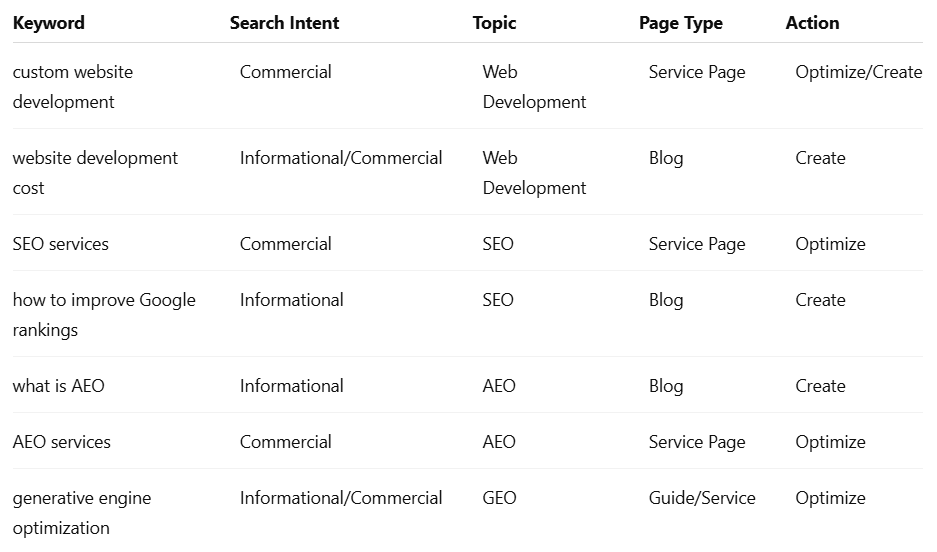
Build a Keyword-to-Content Map
After completing your research, create a keyword-to-content map.
A useful structure is:
Create Content Around Topics, Not Just Keywords
Modern SEO should not be reduced to inserting keywords into articles.
A strong content strategy should demonstrate:
- Expertise
- Relevance
- Clear answers
- Original insights
- Useful examples
- Strong internal linking
- Logical topical relationships
For example, instead of publishing five thin articles targeting variations of "SEO services," create a comprehensive SEO content ecosystem covering:
- SEO fundamentals
- Technical SEO
- On-page SEO
- Local SEO
- Keyword research
- Link building
- SEO reporting
- SEO for AI search
- AEO
- GEO
This creates stronger topical coverage and gives users multiple ways to discover useful information.
Common Mistakes When Using Claude for Keyword Research
Mistake 1: Treating AI suggestions as search volume data
Claude can generate keyword ideas, but keyword suggestions are not automatically verified search metrics.
Mistake 2: Using keywords without understanding intent
A keyword may look relevant but attract users who are not potential customers.
Mistake 3: Creating a separate page for every keyword
Similar keywords can often be addressed with one authoritative page.
Mistake 4: Ignoring first-party data
Your Search Console data, analytics, customer feedback, reviews, and sales conversations can reveal opportunities that generic keyword research cannot.
Mistake 5: Writing solely for search engines
AI-assisted research should ultimately help you create better content for people.
A Simple Claude Prompt for Keyword Research
You can start with a prompt like this:
"Act as an SEO, AEO, and GEO strategist. Analyze my business information, existing website pages, customer questions, and keyword data. Identify relevant keyword opportunities based on business relevance, search intent, customer pain points, and topical authority. Separate informational, commercial, and transactional queries. Identify potential content gaps and existing pages that should be optimized. Group related keywords into topic clusters and recommend whether each cluster should be a new page, service page, blog post, FAQ, or existing-page optimization. Do not assume that AI-generated keywords have search volume. Clearly separate keyword ideas from validated search data."
You can then provide Claude with your business context and supporting data.
How Codzones Can Help With AI-Powered Search
As search continues to evolve, businesses need strategies that work across traditional search engines and AI-powered discovery platforms.
Codzones combines modern digital marketing strategies with website development and AI-focused search optimization to help businesses build stronger digital visibility.
Our approach can incorporate:
- Search Engine Optimization (SEO)
- Answer Engine Optimization (AEO)
- Generative Engine Optimization (GEO)
- Website Development
- Custom Website Development
- CRM Development
- Mobile Application Development
- Content Marketing
- Digital Marketing
The goal is not simply to generate more keywords.
It is to understand what your audience needs, create useful content around those needs, build a technically strong website, and improve your visibility across evolving search experiences.
Final Thoughts
Claude can make keyword research faster and more intelligent by helping marketers understand language, intent, customer problems, questions, and relationships between topics.
But AI should be part of the research process—not the entire research process.
The strongest workflow combines:
Claude + first-party data + keyword research data + competitor research + customer language + search intent + human expertise.
For traditional SEO, this approach can help uncover relevant opportunities and improve existing content.
For AEO, it can help identify the questions people expect search engines and answer engines to address.
For GEO, it can help marketers think beyond traditional keywords and understand the broader questions users may ask AI systems when researching products and services.
As search evolves, the businesses that understand both keywords and conversations will be better positioned to create useful, discoverable content.
If you want to improve your website's visibility across Google and AI-powered search experiences, explore the SEO, AEO, and GEO solutions available through Codzones.